
IVR vs AI Receptionist: Which Is Better for Small Businesses? (2026)
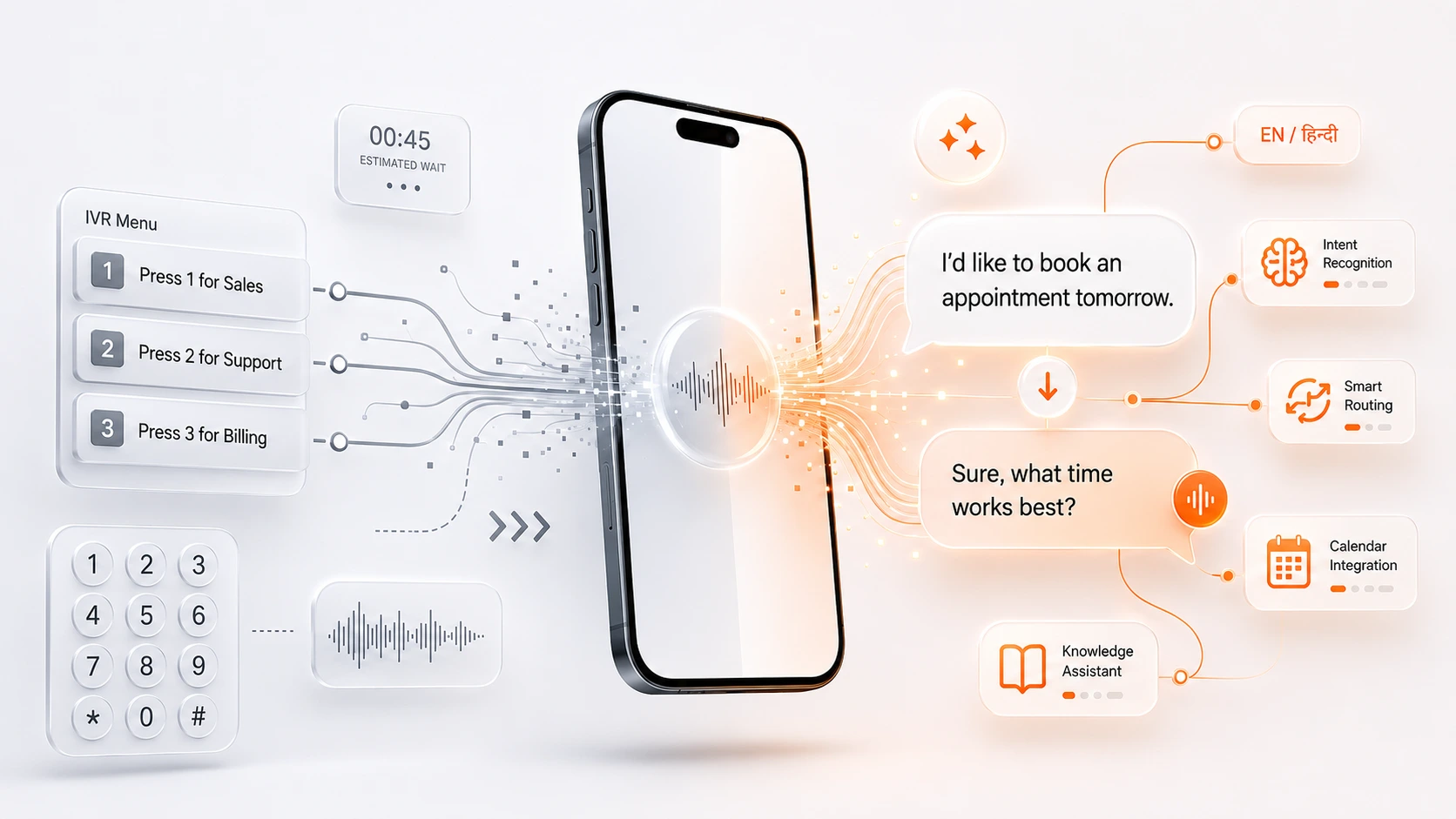
IVR vs AI Receptionist: Which Is Better for Small Businesses?
You call a business with a simple question. Instead of getting an answer, you hear:
“Press 1 for Sales. Press 2 for Support. Press 3 for Billing.”
You wait for the right option. But sometimes, none of the options match what you need. You choose the closest one and hope someone can help.
That’s how a traditional IVR works. It has helped businesses handle calls for years. But today, many callers do not want to sit through long menus. They just want to explain what they need.
An AI receptionist works differently. Instead of asking callers to press buttons, it listens and responds like a normal conversation.
So should small businesses stick with IVR or switch to an AI receptionist? In this guide, we will compare IVR vs AI receptionist systems to help you choose the right option for your business.
What Is an IVR System?
IVR stands for Interactive Voice Response. It routes callers using a fixed menu, such as sales, support, or billing. Some IVR systems have more menus inside the first menu, so callers may hear another list of options after their first choice.
Businesses started using IVR because it answered and routed calls automatically. For simple call routing, it worked well.
But customer expectations have changed. People are used to sending a message on WhatsApp or speaking directly to someone. Fixed phone menus can feel slow in comparison.
Why “Press 1 for Sales” Feels Outdated
IVR works best when customer requests fit neatly into a few options. The problem starts when the caller’s situation does not match the menu.
Imagine someone calling and saying:
“I spoke with your technician yesterday. He asked me to send another photo.”
There is usually no IVR option for that. The caller must guess whether to choose Support, Service or another department.
An AI receptionist can understand that the caller is following up on an earlier support issue. It can ask for their name, phone number or other details, then send the call to the right team or take a message for the technician.
The caller does not need to guess which option to choose. They can simply explain what happened.
Another limitation is that updating an IVR can take time. The business may need to record new messages and change the call flow whenever its services or departments change.
How Does an AI Receptionist Work?
Instead of relying on fixed menus, an AI receptionist lets callers simply explain what they need.
Just speak
Customers do not have to wait for menu options. They can say things like:
- “I want to book an appointment.”
- “What time do you close today?”
- “I need to speak with your sales team.”
- “I called yesterday about my order.”
The AI listens to the caller and replies based on your business information.
AI understands the request
Suppose someone says:
“I want to book a dental appointment tomorrow evening.”
An IVR may ask them to press 1 for appointments and then press another number for a new booking.
With an AI receptionist, the system can understand that the person wants a dental appointment tomorrow and prefers an evening time. Once it understands what the caller needs, it can:
- answer common questions
- book appointments
- collect contact details
- transfer the call to the right person
- ask follow-up questions if something is unclear
Instead of following a fixed menu, callers simply explain what they need.
Languages
India is a country of many languages, so the same business can get calls in Hindi, English, Hinglish and different regional languages. With a traditional IVR, callers usually have to pick a language before anything else:
“Press 1 for English. Hindi ke liye 2 dabayein.”
That’s one more step before they can even say why they called.
An AI receptionist skips all of that. It can talk in Hindi, English, Hinglish and other regional languages, so callers just speak the way they normally would.
ReceptionMonk™ can also detect the caller’s language automatically.
IVR vs AI Receptionist Comparison
Here is a simple comparison of both systems.
| Area | Traditional IVR | AI Receptionist |
|---|---|---|
| Setup time | Requires menus, recordings and call routing | Requires business information and setup |
| Customer experience | Callers choose from fixed options | Callers can simply say what they need |
| Cost | Setup, phone service, recordings and maintenance | Subscription, phone service and AI usage |
| Flexibility | Works only with options added to the menu | Can understand and handle different types of calls |
| How it works | Buttons and recorded messages | Spoken conversation |
| Languages | Usually needs separate recordings and menus | Can support multiple languages where available |
| Availability | Usually follows business routing | Can answer calls 24/7 |
ReceptionMonk supports both AI receptionist workflows and traditional IVR, so businesses can choose the approach that fits them best.
Cost Comparison
Price matters, but it is not the only thing to compare.
If your calls only need simple routing, IVR may be enough. If your team spends hours answering the same questions or booking appointments, an AI receptionist may save more time.
How much you save depends on how many calls you receive and how much work the AI handles.
When IVR Still Makes Sense
IVR still works well in the right situations. It is useful when callers follow a simple process.
For example, IVR can work well for:
- routing calls between two departments,
- checking an account balance,
- making an automated payment,
- entering a secure PIN,
- or choosing from a small number of fixed services.
Some businesses already have a simple IVR that works well. Their customers understand it, and the menu does not cause confusion.
In that situation, switching to an AI receptionist may not be worth the extra cost. IVR is still a good choice when customers usually call for the same few reasons.
If a traditional IVR is the right fit for your business, ReceptionMonk supports custom IVR call flows as well. You can use a simple menu system or an AI receptionist, depending on how you want your calls to be handled.
How to Choose Between IVR and an AI Receptionist
The right choice depends on the calls your business receives every day. Before changing your phone system, think about what your callers usually need. This is especially important when moving beyond fixed business phone systems.
Choose a traditional IVR when:
- Most calls fit into two or three clear options.
- Callers already understand the menu.
- You only need basic call routing.
- You want every caller to follow the same steps.
- You do not need to collect much information during the call.
Choose an AI receptionist when:
- Callers ask many different types of questions.
- Your team spends a lot of time booking appointments.
- Your team regularly collects lead information over the phone.
- Customers speak in Hindi, English or Hinglish.
- Your business information changes often.
- Customers often call after business hours.
- You want to answer common questions before transferring calls.
There is no single best option. Choose the system that matches how your customers actually call your business.
Try ReceptionMonk’s AI Receptionist
Want to hear how it works? Call the demo number and try a few real questions, book an appointment, or speak in Hinglish.
If you’re ready to try it for your own business, review our pricing or create an account to test everything yourself.
Start free with ₹250 one-time credit
₹250 is a one-time signup credit.